Wednesday, January 5, 2011

A Romp in the Old City

 After our extensive tour of the Old City, our guide Ali led us to Al Quds University to meet with a few of its students. Nanara and (name) treated us to a lunch of falafel sandwiches (which, after trudging around the Old City all morning, was a welcome sight) and discussed with us the life of a Palestinian student in Jerusalem. While their studies go quite well, the social disparity between the Israelis and Palestinians still touches other aspects of their lives. The check points, for example, make it very difficult for them to visit their families, and impossible for their families to visit them. What was a fifteen-minute trip turns into an hour-long wait to pass through the wall.
We also were treated to a tour of the ancient baths located under the university. Our guide showed us the clever mechanisms that provided for steam baths, hot and cold-water treatment, and ventilation systems. Though they have long been out of use, the impressive designs still speak to the genius of the city’s ancestors.
We then departed Al Quds, and enjoyed a few hours of roaming around the Old City, taking pictures, perusing the countless shop, and enjoying (hopefully!) the wild experience of negotiation prices with fanatic salespeople. Everything one could imagine was no more than a few steps away; souvenirs, jewelry, clothing, pharmacies, meat, spices, candy, electronics – there was even a shop devoted to t-shirts with Hebrew logos of American sports teams.

 Spices
By MacLean Cadman

There was also the opportunity to more closely inspect some of the Old City’s religious sites. One of these is the Wailing Wall, a towering behemoth that stands as the last remains of the Old Temple and a major prayer site for Jews. There are two parts; a smaller wall, tucked away in the recesses of the Old City’s catacombs, and the larger wall that stands nearby Ibrahimi Mosque. We visited the smaller wall, which was much less crowded than its counterpart. Between the stones and crumbling mortar are countless pieces of folded paper. 

 Prayers in the Wailing Wall
By MacLean Cadman


Jews traditionally write prayers or messages to God and insert them into cracks in the Wall, like tiny messages in a bottle that might somehow float their way up to God. We later saw the larger part of the Wailing Wall from a nearby viewpoint. Its location provides a picturesque scene that includes the Wall, the Dome of the Rock, and the Mount of Olives in the distance.


The Wailing Wall, Dome of the Rock, & Mount of Olives

 By MacLean Cadman

With bags stuffed full of souvenirs and wallets near empty of shekels, we meandered back to St. George’s to prepare for that night’s service. I’ll pass the baton onto Paulina for a description of that.
Well, tomorrow it’s to Nazareth and the tail end of our pilgrimage. We’ll all be seeing you before long!

MacLean Cadman
Communication, 2012
Boston College

Ecumenical Prayer Service


This evening our group attended a memorial service for the Christians who were killed in Alexandria, Egypt, a few days ago by a bomb. The service was organized by Sabeel, an Ecumenical Center of Liberation Theology in Jerusalem run by mainly Palestinians.  A few months ago, there was a bombing of a Christian church in Iraq. Many people fear that there soon may be a wave of attacks on Christians throughout the Middle East. The service we attended was an Ecumenical service, consisting of many different Christian denominations from Catholic to Orthodox to Lutheran and Episcopal. Bishops and priests from all these denominations attended the service and participated in it, including our bishop, Tom Shaw.


Media from Palestine, Lebanon, and Egypt attended the service, filming the entirety of it. Tonight (8pm Israel/Palestine time, 1pm Boston time), the service was on  both the Palestinian and Lebanese news. On Friday, the entire service will be broadcast on CTV which is the Coptic TV, a denomination of Christianity known  as Coptic Christians who have origin in Egypt.


The main purpose of the memorial service was to use the recent tragic bombings of Christians in the Middle East in a positive way, to work against the violence in a peaceful way. We are continually hoping and praying for peace between and among all religions.


All photos and text are by:
Paulina Muratore
Class of 2013, International Relations
Boston University


The Dome of the Rock & Al-Asqa Mosque


Damascus Gate
By MacLean Cadman

This morning, we found ourselves entranced as we climbed the cobbled roads of Jerusalem's Old City through shafts of light filtering into the narrow openings along the street-side markets and cafes. We entered the Old City through the Damascus Gate and swiftly wound around in the bustling maze along the Via Dolorosa, where Jesus walked his last steps before his crucifixion. Our goal was to arrive at the Dome of the Rock on time--having been granted access, just this morning, to both the shrine and the Al-Asqa Mosque, something that does not happen very often these days.

After passing through the crowds and the rush of the Old City, we passed through a security checkpoint and entered into a very quiet Temple Mount, where we could hear birds sing and feel the breeze blow. It was a beautiful morning in Jerusalem. Just across the courtyard, we saw the 7th century golden dome rising above the sacred Islamic shrine, and it took our breath away.

Dome of the Rock
By MacLean Cadman

Once all the women in our group had covered our heads with scarves and put on large, flowery skirts over our jeans, we were escorted up the marble staircase to the Dome of the Rock, a magnificent octagonal structure built using a Byzantine architectural style for the dome. Below the dome, the building is covered in colored porcelain tiles to create engaging geometric patterns that are echoed in the interior. We took off our shoes and entered the shrine, first built as a resting place for pilgrims to the mosque next door.


Scarves & Skirts
By MacLean Cadman

In the shrine, we saw men, women, and children at prayer, study, and rest. We had the opportunity to go down below the dome into one of the niches beneath the rock to touch the holy rock and observe prayers taking place in this holiest of sites for Muslims. The experience was truly breathtaking for many of us. The calm beauty all around us--gorgeous, intricate stained glass windows; thick carpets donated by the King of Jordan; an ornate ceiling held up by wide marble columns. We wished we'd been able to stay longer to soak up the spiritual energy of the place.
After leaving the Dome of the Rock, we walked across the plaza to the Al-Asqa Mosque, which means "the Farthest Mosque from Mecca," our guide told us. Another beautiful structure, the mosque was surrounded by groups of men and women studying the Koran and was filled with people in prayer. Our experience of this place included a profound sense of devotion to God and to living a good and peaceful life, which made it as hard to leave the mosque as it had been to walk out of the Dome of the Rock.

Inside the Mosque
By MacLean Cadman

In my Father's house, there are many mansions. ~ John 14.2

~ Shan Overton
PhD student, Theology and Education
Boston College

Yad Vashem & East Jerusalem

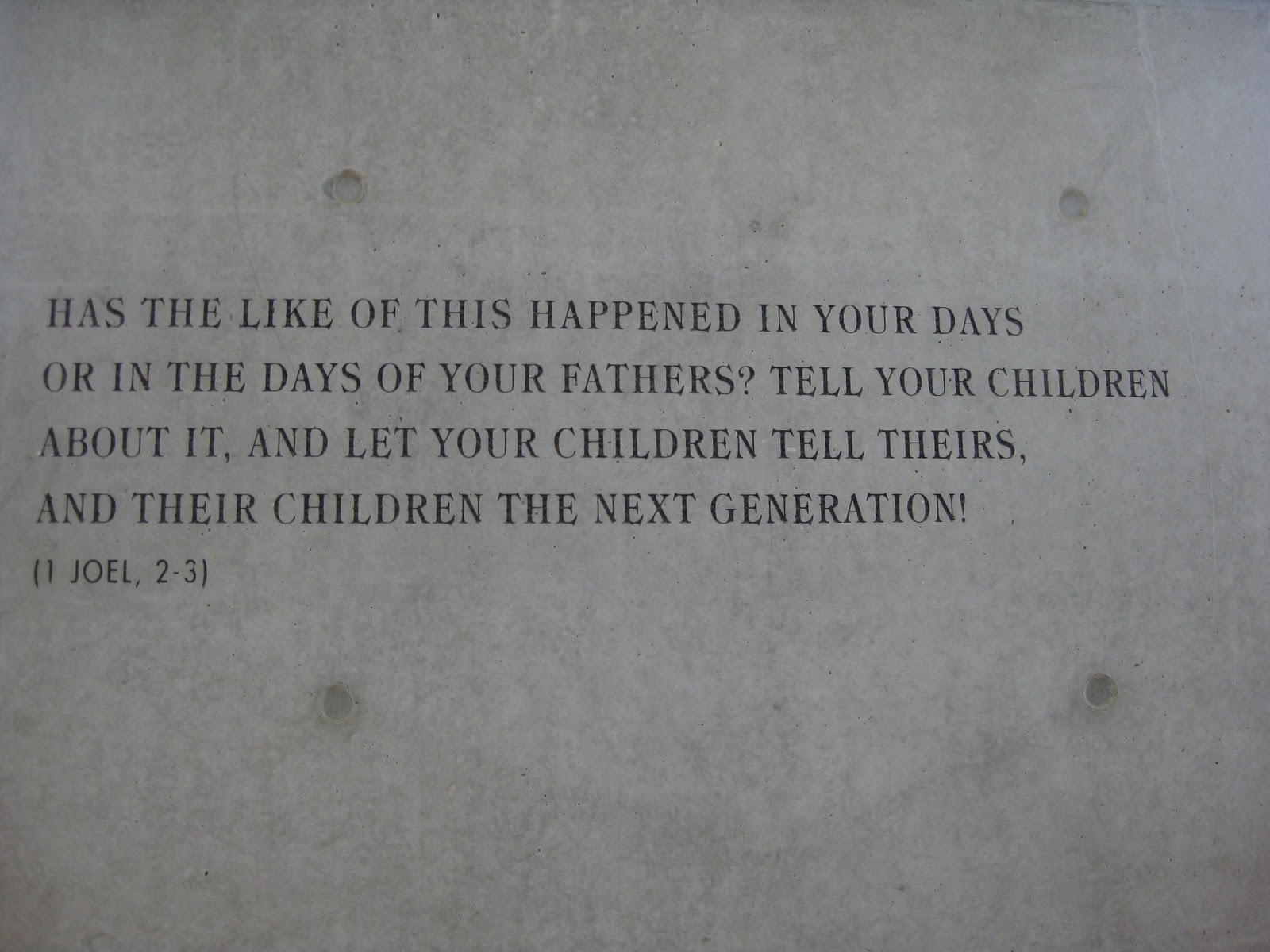
A country is not just what it does--it is also what it tolerates.
--Kurt Tucholsky, German essayist of Jewish origin
Quotation from Vad Yashem, the Holocaust Museum

Vad Yashem, the Holocaust Museum
Monument at Vad Yashem
by Paulina Muratore


At the Children's Memorial
By MacLean Cadman
A view of the valley from Yad Vashem.
Paulina Muratore


East Jerusalem
A market in East Jerusalem.
by Paulina Muratore

The Winding Wall
By MacLean Cadman


A Bedouin encampment outside of East Jerusalem.
by Paulina Muratore

A Demolished Palestinian Home
By MacLean Cadman


Walking down the hill to the Peace Center of
the Israeli Committee Against Home Demolitions (ICAHD)
with our guide, Yahav.
by Paulina Muratore


Mural at ICAHD's Peace Center.
by Paulina Muratore


Maqluba (a.k.a. Upside Down), a traditional Palestinian lunch. YUM!
by Paulina Muratore

Monday, January 3, 2011

Ramallah & the Dead Sea

Dear Friends, 
We spent today in Ramallah in the West Bank and on the Dead Sea. It was another intense but fruitful day. We offer to you the Scripture passage we carried with us for the day and reflected upon at evening's end, followed by several photographs of our journey.
~ Shan Overton


Because of the Lord's great love we are not consumed, for His compassions never fail. They are new every morning; great is Your faithfulness.
~ Lamentations 3.22-23

Visit with The Rev. Manuel Musallem
in Ramallah
College Pilgrims with The Rev. Manuel Musallem,
Roman Catholic priest who served in Gaza for 14 years
and current Director of Christian-Islamic Peace Center
by Judith Stuart


Meeting with Hanan Ashrawi
in Ramallah
Diocese of Mass College Pilgrims with Hanan Ashrawi,
Founder and Secretary General of MIFTA,
the Palestinian Initiative for the Promotion of Global Dialogue and Democracy
by Judith Stuart


The Rev. Judith Stuart with Hanan Ashrawi
by MacLean Cadman

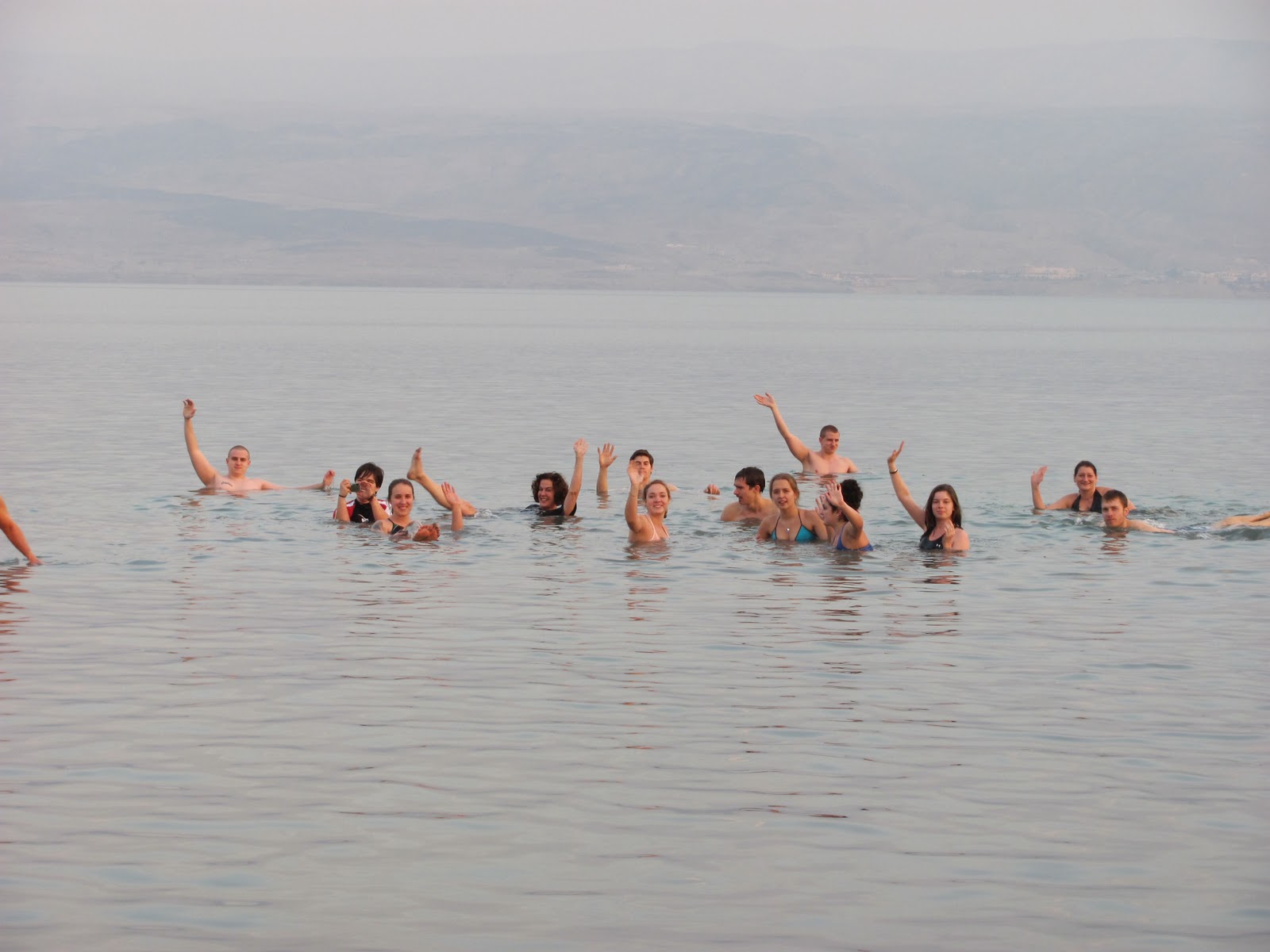
Playing in the Dead Sea
Bobbing in the salt water!
by Judith Stuart


A bunch of us in the mud!
by Judith Stuart

Because of the Lord's great love we are not consumed, for His compassions never fail. They are new every morning; great is Your faithfulness.
~ Lamentations 3.22-23

Sunday, January 2, 2011

Going There: Aida and Hebron

Today, we visited Aida Refugee Camp and Hebron in the West Bank. Our own words cannot possibly describe all we have seen and heard, so we share with you several photographs because a picture is worth a thousand words. But first, a poem by R.S. Thomas, which articulates both the suffering and the grace we have witnessed.
 
The Coming
by R. S. Thomas
 
And God held in his hand
A small globe. Look he said.
The son looked. Far off,
As through water, he saw
A scorched land of fierce
Colour. The light burned
There; crusted buildings
Cast their shadows: a bright
Serpent, A river
Uncoiled itself, radiant
With slime. On a bare
Hill a bare tree saddened
The sky. many People
Held out their thin arms
To it, as though waiting
For a vanished April
To return to its crossed
Boughs. The son watched
Them. Let me go there, he said.
Aida Refugee Camp
Entrance to Aida
by Paulina Muratore

 A wall in Aida listing refugees' home villages.
by Paulina Muratore

Our lunch hosts at the Lajee Center in Aida.
by Paulina Muratore

 The Wall, sometimes called the Apartheid Wall, sometimes called The Fence.
by Paulina Muratore 

Children in Aida.
by Paulina Muratore
 

Ibrihimi Mosque
The beautiful room for prayer.
by MacLean Cadman


Several of us prepared for entering the room for prayer.
by MacLean Cadman

The 1,600 year old minbar, where the imam stands to deliver sermons.
by Paulina Muratore

Sarah's Tomb
by Paulina Muratore


Meeting Israeli Soldiers
At the checkpoint near the Ibrihimi Mosque.
by MacLean Cadman


Getting a little exercise!
by MacLean Cadman


Soldiers at our last checkpoint leaving Hebron.
by MacLean Cadman


Saturday, January 1, 2011

Seek Peace and Pursue It

This entry is part two of two entries for Saturday, January 1.

Barbed Wire Fence on Olive Tree Terrace
by Paulina Muratore
Class of 2013, International Relations
Boston University

One of the gifts of coming to a disputed land is meeting people who want to resolve conflicts not with violence but with civility, creativity, and a concern for the common humanity of everyone involved. Today, we met two such people, one a university professor who left a job at Yale University to focus on empowering non-violent approaches to the Israel-Palestine conflict from his home in Bethlehem; the other, a farmer committed to establishing good relations with his neighbors, to creating beautiful art, theater, and music with children in order to promote peace, and to making a space where people of all traditions and backgrounds can come together in peace. These men, Mazin B. Qumsiyeh, professor at Bethlehem and Birzeit Universities and a leader in several civil and solidarity movements, and Daoud Nassar, owner of Daher's Vineyard and director of Tent of Nations, are Palestinians with a passion for justice and peace. Their long-term dedication to the creation of opportunities for mutual respect between Palestinians and Israelis, despite the ongoing discord about land ownership and use, water access, human rights issues, and much more, was both a sobering and an energizing aspect of our journey today.

We met Qumsiyeh after spending the morning at the Church of the Nativity in Bethlehem. He welcomed us with hospitality, including a delicious Turkish coffee, and talked to us about his activist work. Qumsiyeh is deeply concerned about what is happening to Palestinians as Israelis build more walls, annex more land, uproot profitable and very old olive trees and vineyards, tap water resources underneath Palestinian-owned property, require Palestinians to carry special IDs, and control Palestinian movement throughout the region. It is clear that, despite his concerns for these and many other problems, Qumsiyeh follows the lead of globally-respected persons such as Mohandas Gandhi, Martin Luther King, Jr., and Desmond Tutu, as he tries to respond in a non-violent manner that still makes his political points. He told us what it means to him to be a Palestinian at this time, saying, "to exist is to resist." Resisting, for Qumsiyeh and the people he works with, does not mean violent acts; instead, resisting means farmers picking olives in front of bulldozers and women taking sheep to pasture in forbidden areas, children going to school in the streets when their schools are blocked off by Israeli military units, writing books and talking to groups about peace and justice, hugging trees about to be torn down or burned, refusing to pay taxes without representation, and other similar kinds of actions. His message is a message of hope and empowerment, one that draws inspiration from the anti-Apartheid movement, women's suffrage and feminist movements, and the like.

After we left Qumsiyeh, we had much to ponder on the short bus ride and walk across the terraced fields and up the hillside to Daher's Vineyard just outside of Bethlehem. We arrived at the farm to a delicious lunch prepared for us by Daoud Nassar and his family, after which Nassar told us his family's story of land ownership in a rich farming area where Israelis are currently annexing land and building new settlements very rapidly.

Lunch in a Cave at Daher's Vineyard
by Paulina Muratore

 The Nassar family bought their land in 1916 and have been farming it continuously in vineyards and olive trees and living in the caves on the land for three generations, but they have had to mount an extraordinary legal battle with Israelis for more than ten years in order to keep it despite having clear title to the entire property. The family was offered a large sum of money to give up the property rights to their 100 acres, but they refused because, Nassar said, "The land is our mother. We cannot sell our mother." They have endured nine demolition orders, all rescinded thus far, but they fear that the bulldozers could arrive at any time to destroy the few structures on the property. In addition to fighting the battle in court, the Nassar family's response to this situation has been to make something good come from the conflict. They host a summer camp for children and youths from the area; invite people, including Israeli settlers, to join them in working the land and sharing meals; and have been inventive in creating a self-sufficient farm with solar energy, rain water tanks, organic farming techniques, and good use of the natural caves on the property. They are not interested in theoretical peace-making but try to live it every day, from the grassroots up, whether they are engaged in hosting visitors like us or crossing through an Israeli check-point. As Nassar told us, "We refuse to be enemies." His goal, and that of his family and Tent of Nations is to develop friendships that will enable them to cross boundaries and solve problems together.

 Peaceful Resistance, Daher's Vineyard
by Paulina Muratore

As we said our goodbyes to Nassar and headed back down the hill and across the fields to the bus, we were struck by how these two good men are, in their own ways, seeking and pursuing a future of peace. Both want unity with their fellow human beings, and one approaches it by researching and writing books and engaging in non-violent political actions while the other plants olive trees and invites everyone to participate in the planting and the playing afterward. Their kind hospitality, their honesty, their diligence in the face of many obstacles, and their humor will stay with us through the rest of our journey and as we return home to all of you.

~ Shan Overton
PhD student, Theology & Education
Boston College

Behold, how good and how pleasant it is 
for brethren to dwell together in unity!
~ Psalm 133 (KJV)

Most of Our (Very Unified) Group at Church of the Nativity!
by Paulina Muratore