Showing posts with label MacLean Cadman. Show all posts

Sunday, January 9, 2011

The World We Leave Behind

Well everyone, we are on our way back. I’m sitting here in Ben Gurion, pecking away at the keyboard of Judith’s undersized laptop. It seems like just yesterday that we passed through this same place, but at the same time so much has happened since then. It has been an incredible week for all of us; I think it’ll take some time to really process what we’ve experienced and discover the full meaning of the world we are leaving behind – but one we will never forget.

Hand it to Bob and Maurine – a day walking around the town that Jesus grew up in was the perfect way to wrap up our week-long pilgrimage to Israel and Palestine. We met our tour guide, Azar, after breakfast and began hiking up the hill to visit Don Bosco, an Arab school. 

 
The Church at Don Bosco

The view was simply incredibly; the entire city of Nazareth was spread out before us, and Mt. Precipice – where Luke says an angry mob once attempted to throw Jesus off a cliff – stood tall in the distance.
We then descended the hill, passing through the busy marketplace to the Basilica of the Annunciation, which stands over the location where Mary was visited by an angel. We followed Azar inside, passing by the ancient Crusader and Byzantine ruins. There’s not much left – only a small grotto – but the altar remains inside. The walls are lined with beautiful mosaics that almost every country in the world has donated to the basilica (to be honest, ours isn’t particularly stunning). The upper level is entirely dedicated to Mary.

 Basilica of the Annunciation

We stopped by St. Joseph’s and the Greek Orthodox Church before heading to the Sisters of Nazareth Convent.  Our first order of business there was to explore the underground ruins beneath the convent, which were discovered in the waning years of the 19th. century. There are some pretty impressive archeological designs: 1st century tombs (which had housed the skeleton of what excavators believed to be a bishop), and structures build by both the Crusaders and the Byzantines. One of the tombs in particular garnered our interest – one which shared the same model of the tomb that Jesus was resurrected in.

After a while poking around the musty (but still fascinating) ruins, we returned outside. Bob handed us each some shekels, and set us loose upon the Nazareth marketplace to find our own lunches and peruse the shops and sights. 

 The Nazareth Marketplace

There were a few pretty good finds, including a sweet shop with everything from Turkish Delight to honey balls (amazing!), and an Arabic pizza parlor that served pizza on pita bread. Once we were all shekel-ed out, we returned to the convent.

We were all looking forward to the last event on the program: a visit from Knesset member Haneen Zoabi, one of only 11 Palestinians to represent the 1.2 million that live within the country. She spoke passionately to us about the political aspect of Palestinian self-identity. While Palestinians with Israeli citizenship are commonly referred to as Arab Israelis, Zoabi rejects that term as a denial of her own historic and cultural identity as a Palestinian. 

  Haneen Zoabi (far left)

To be an Israeli citizen, she told us, the country demands that they deny their own Palestinian identity. To call herself Palestinian is to be “disloyal” to the state. Much of her work is to reverse that notion, and to make a Palestinian heritage a thing of pride and not of disloyalty. We hope and pray that she will help lead the way to political and social equality for all Palestinians.

And with that, our pilgrimage came to a conclusion. We returned to St. Margaret’s for a final debrief and dinner.  As we were to leave Nazareth at 3am, some chose an early bedtime, while a few bolder ones (those crazy kids) elected to stay up all night.

And so we return to the States. Barely a week has passed, but so much has changed. We return with an awareness of a beautiful and holy land halfway across the globe.  The land where our Lord lived, ministered, and died for us. We have followed in His footsteps to continue that never-ending quest to be close to Him. We have prayed, and we have felt His presence.

But we also return with an awareness of a terrible and cruel land. We have witnessed the occupation and oppression of the Palestinian people, on the same earth that Jesus called us to show love, kindness, and mercy to all. And so we are called to do what we can. Jesus tells us that helping the least of His brothers is to do His work, and so that is our mission.

Just to conclude, I’d like to thank some who helped to make this wonderful pilgrimage possible. Thanks to all of you, for your constant support over the past few months; thanks to Bob and Maurine Tobin, who planned and led the trip and provided a wealth of knowledge and understanding to us;  Judith, who helped organize and lead the trip, and was also a wonderful resource to all of us who needed anything; Brandy, who managed our finances; Trish, who helped chaperone; Shan, who created and maintained this blog; Bishop Tom Shaw, who was an incredible spiritual resource the days that he was with us; and Mohammed, our driver who not only can maneuver a gigantic tour bus with the precision of a brain surgeon, but was an amazing friend to us (he even got us snacks when he was waiting for us to return!). You have created an experience that none of us will forget.

And we’ll be seeing you all, our families and friends, very soon. Thanks for taking the time to read and follow us on our journey. We look forward to returning home, but we will never forget what we have experienced and learned here. 

God bless,
MacLean Cadman
Communication, 2012
Boston College

Thursday, January 6, 2011

From Jerusalem to the Sea of Galilee

For some of our group, today started at 4am so that we could spend time in the Old City of Jerusalem without the crowds. The early risers visited the Holy Sepulchre, where it is believed that Jesus was crucified and buried. During the day, the crowds here are unbearable, so the early morning visit was a huge success. At 7:30 this morning, we packed into the bus with all of our luggage and headed toward Nazareth. The bus ride took approximately three hours, and the scenery was breathtaking.

We arrived at the Mount of Beatitudes, where we had some time to pray and reflect on our experiences of the past five days. It was quite a change of pace from our past few days. We were able to find some peace after the turmoil and suffering that we’ve witnessed. Following our time of reflection in the beautiful gardens of the Mount of the Beatitudes overlooking the Sea of Galilee, we had lunch at the convent of the Mount of the Beatitudes. The staff served us a filling meal of pasta, bread, and fish from the Sea of Galilee called Peter’s Fish. An entire fish was served to each of us, as well as French fries.


Lunchtime at the Mount of Beatitudes!

Peter's Fish -- Our Lunch. Say Hello!

Once we were well fed, we headed toward Capernum where we got closer to the Sea of Galilee and to some ancient ruins. Some of us dipped our toes into the Sea. It was a moving experience to be walking around where Jesus did most of his ministry. Our change of pace today gave all of us some peace, through which we have been processing our trip as it comes to a close.
College Pilgrims in the Synagogue at Capernaum


All text by Paulina Muratore,
Class of 2013, International Relations
Boston University

All photographs by MacLean Cadman
Class of 2012, Communications
Boston College

From Capernaum to Nazareth

After touring Capernaum, we traveled a short ways along the shore of the Sea of Galilee to the Church of the Primacy of Peter. A short walk separates the church from the nearby parking lot and tourism center (which featured a fountain with a variety of brightly colored fish). Once we had our fill of exploring, we hiked up the hill to the church.
There was plenty of exploring to do up there as well. The church itself is a beautiful stone structure, built upon the ruins of a 4th century chapel. According to tradition, it is the same spot where Jesus laid out a breakfast of bread and fish for His disciples two thousand years ago. The Rock of St. Peter protrudes from the church’s floor, a unique replacement for the typical altar. Outside, the church stands a stone’s throw from the Sea of Galilee; the distant shores of Syria shimmered through the mist rising from the water.  The entire scene creates an atmosphere of peace and spiritual richness.
But we weren’t there just to poke around; our clergy team had prepared the outside worship area for a special confirmation service for one of our students, Hannah. It was an amazing thing to see someone confirmed at the Rock of St. Peter, and Hannah was more than a little excited for it. And it was perfect; the sun was setting, the air was cool, and the birds were singing as Bishop Tom confirmed her and led us all through a reaffirmation of our confirmation vows.

The Confirmation at the Sea of Galilee

After some extended photo ops, we packed up and left for St. Margaret’s Guesthouse in Nazareth. We were in for another treat; as we rounded the hills that surround the Sea of Galilee, a beautiful sunset lit up the western sky, prompting several “ooh”s and “aah”s and a barrage of camera flashes.
Sunset in the Galilee


The courtyard at the Guesthouse.

An hour later, we arrived at the Guesthouse with just enough time to unpack and unwind before dinner. Tomorrow’s it, folks. We’ll have one more entry then an 8:00 am departure from Tel Aviv (after getting up at 3am!). See you all soon!

All text and photographs by
MacLean Cadman
Communication, 2012
Boston College

Wednesday, January 5, 2011

The Dome of the Rock & Al-Asqa Mosque


Damascus Gate
By MacLean Cadman

This morning, we found ourselves entranced as we climbed the cobbled roads of Jerusalem's Old City through shafts of light filtering into the narrow openings along the street-side markets and cafes. We entered the Old City through the Damascus Gate and swiftly wound around in the bustling maze along the Via Dolorosa, where Jesus walked his last steps before his crucifixion. Our goal was to arrive at the Dome of the Rock on time--having been granted access, just this morning, to both the shrine and the Al-Asqa Mosque, something that does not happen very often these days.

After passing through the crowds and the rush of the Old City, we passed through a security checkpoint and entered into a very quiet Temple Mount, where we could hear birds sing and feel the breeze blow. It was a beautiful morning in Jerusalem. Just across the courtyard, we saw the 7th century golden dome rising above the sacred Islamic shrine, and it took our breath away.

Dome of the Rock
By MacLean Cadman

Once all the women in our group had covered our heads with scarves and put on large, flowery skirts over our jeans, we were escorted up the marble staircase to the Dome of the Rock, a magnificent octagonal structure built using a Byzantine architectural style for the dome. Below the dome, the building is covered in colored porcelain tiles to create engaging geometric patterns that are echoed in the interior. We took off our shoes and entered the shrine, first built as a resting place for pilgrims to the mosque next door.


Scarves & Skirts
By MacLean Cadman

In the shrine, we saw men, women, and children at prayer, study, and rest. We had the opportunity to go down below the dome into one of the niches beneath the rock to touch the holy rock and observe prayers taking place in this holiest of sites for Muslims. The experience was truly breathtaking for many of us. The calm beauty all around us--gorgeous, intricate stained glass windows; thick carpets donated by the King of Jordan; an ornate ceiling held up by wide marble columns. We wished we'd been able to stay longer to soak up the spiritual energy of the place.
After leaving the Dome of the Rock, we walked across the plaza to the Al-Asqa Mosque, which means "the Farthest Mosque from Mecca," our guide told us. Another beautiful structure, the mosque was surrounded by groups of men and women studying the Koran and was filled with people in prayer. Our experience of this place included a profound sense of devotion to God and to living a good and peaceful life, which made it as hard to leave the mosque as it had been to walk out of the Dome of the Rock.

Inside the Mosque
By MacLean Cadman

In my Father's house, there are many mansions. ~ John 14.2

~ Shan Overton
PhD student, Theology and Education
Boston College

Monday, January 3, 2011

Ramallah & the Dead Sea

Dear Friends, 
We spent today in Ramallah in the West Bank and on the Dead Sea. It was another intense but fruitful day. We offer to you the Scripture passage we carried with us for the day and reflected upon at evening's end, followed by several photographs of our journey.
~ Shan Overton


Because of the Lord's great love we are not consumed, for His compassions never fail. They are new every morning; great is Your faithfulness.
~ Lamentations 3.22-23

Visit with The Rev. Manuel Musallem
in Ramallah
College Pilgrims with The Rev. Manuel Musallem,
Roman Catholic priest who served in Gaza for 14 years
and current Director of Christian-Islamic Peace Center
by Judith Stuart


Meeting with Hanan Ashrawi
in Ramallah
Diocese of Mass College Pilgrims with Hanan Ashrawi,
Founder and Secretary General of MIFTA,
the Palestinian Initiative for the Promotion of Global Dialogue and Democracy
by Judith Stuart


The Rev. Judith Stuart with Hanan Ashrawi
by MacLean Cadman

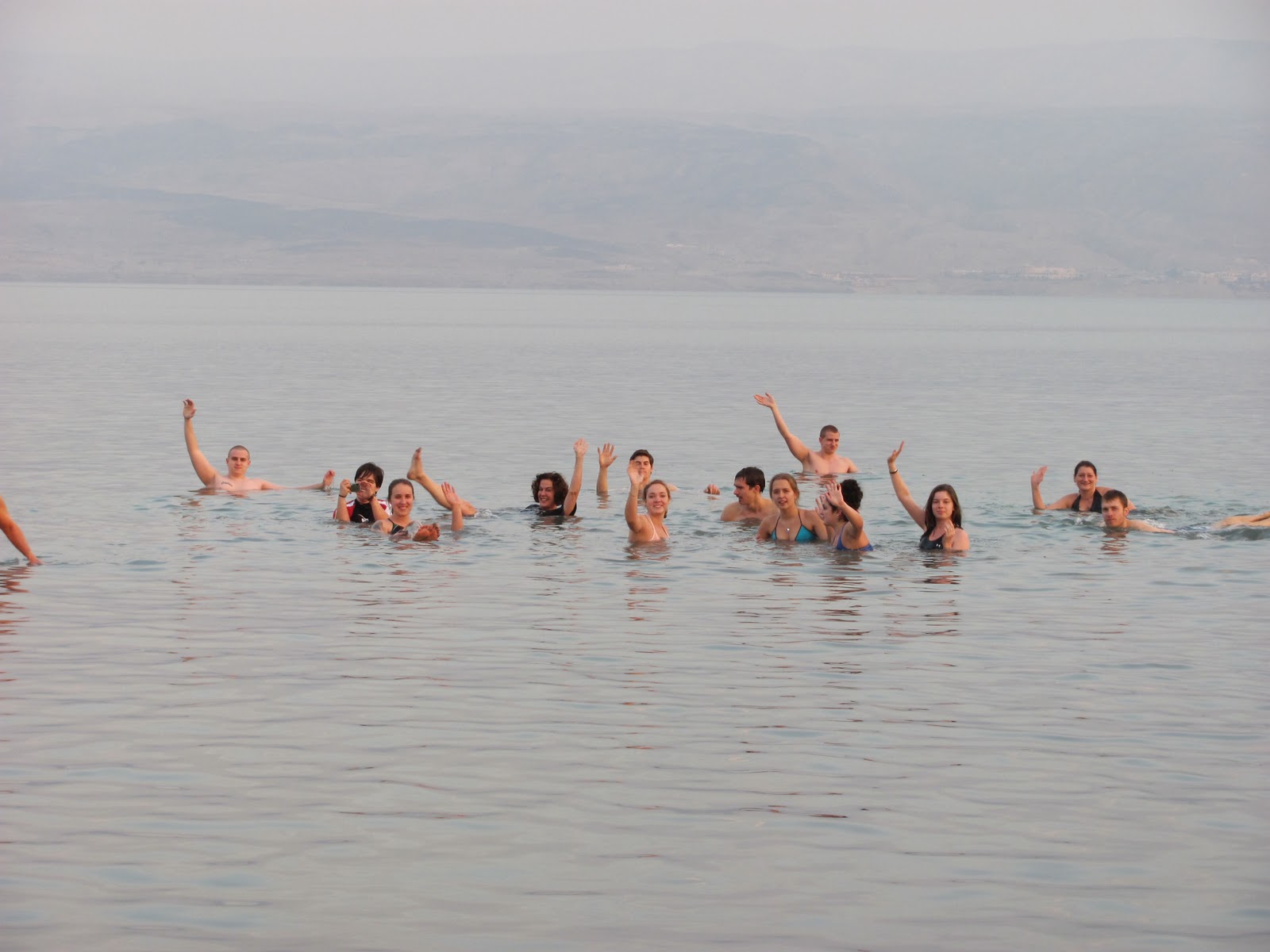
Playing in the Dead Sea
Bobbing in the salt water!
by Judith Stuart


A bunch of us in the mud!
by Judith Stuart

Because of the Lord's great love we are not consumed, for His compassions never fail. They are new every morning; great is Your faithfulness.
~ Lamentations 3.22-23

Sunday, January 2, 2011

Going There: Aida and Hebron

Today, we visited Aida Refugee Camp and Hebron in the West Bank. Our own words cannot possibly describe all we have seen and heard, so we share with you several photographs because a picture is worth a thousand words. But first, a poem by R.S. Thomas, which articulates both the suffering and the grace we have witnessed.
 
The Coming
by R. S. Thomas
 
And God held in his hand
A small globe. Look he said.
The son looked. Far off,
As through water, he saw
A scorched land of fierce
Colour. The light burned
There; crusted buildings
Cast their shadows: a bright
Serpent, A river
Uncoiled itself, radiant
With slime. On a bare
Hill a bare tree saddened
The sky. many People
Held out their thin arms
To it, as though waiting
For a vanished April
To return to its crossed
Boughs. The son watched
Them. Let me go there, he said.
Aida Refugee Camp
Entrance to Aida
by Paulina Muratore

 A wall in Aida listing refugees' home villages.
by Paulina Muratore

Our lunch hosts at the Lajee Center in Aida.
by Paulina Muratore

 The Wall, sometimes called the Apartheid Wall, sometimes called The Fence.
by Paulina Muratore 

Children in Aida.
by Paulina Muratore
 

Ibrihimi Mosque
The beautiful room for prayer.
by MacLean Cadman


Several of us prepared for entering the room for prayer.
by MacLean Cadman

The 1,600 year old minbar, where the imam stands to deliver sermons.
by Paulina Muratore

Sarah's Tomb
by Paulina Muratore


Meeting Israeli Soldiers
At the checkpoint near the Ibrihimi Mosque.
by MacLean Cadman


Getting a little exercise!
by MacLean Cadman


Soldiers at our last checkpoint leaving Hebron.
by MacLean Cadman


Saturday, January 1, 2011

Visit to Bethlehem

This is part one of a two-part entry for January 1, 2011.

Hello again to all our followers,


Today was a nonstop barrage of action. After breakfast, we drove to Bethlehem and its Church of the Nativity, where tradition tells us Jesus was born. The trip was only seven or so miles, but there was plenty to see on the way – another glimpse of the Old City, some very cool ancient architecture, and the controversial wall that separates Israel from the West Bank. Some call it a security barrier, some call it the Apartheid Wall. Whatever its name, it is quite an intimidating sight – a concrete behemoth standing over twenty feet, guarded by Israeli soldiers toting machine guns.

 Meeting Our Guide at the Church of the Nativity
by Paulina Muratore


After passing through the checkpoint, we arrived at the Church of the Nativity and met our tour guide, Isa (which is the Arabic version of “Jesus”). He led us inside, chuckling as we were forced to crouch while entering the tiny stone door that had been built hundreds of years ago to prevent people from bringing livestock into the church. 

 Door to Nativity
by MacLean Cadman

We stepped into an enormous cathedral, lined by giant pillars and decorated with countless chandeliers, paintings, and relief sculptures. Everywhere we looked, there was something that demanded closer attention – a faded script on a pillar, shimmering jewels on the chandeliers, various crosses and other religious symbols etched into the stone. Isa explained how the church had been rebuilt three times over the millennia, and how each had added to its structure and décor.

 The Crowded Descent into the Grotto
by MacLean Cadman

Then it was time to descend to the grotto that was built – supposedly – upon the stable where Jesus was born. As Bob Tobin said about a few holy sites today, “It may not be the spot, but it is the place.” Pushing and shoving – we were competing with several other tour groups to enter the grotto, including an especially determined Indian family – we stepped into the cramped space where our Lord Christ was born. A silver fourteen-point star marked the exact place where Mary gave birth. As was custom, people were kneeling to touch or kiss the star and whisper a quick prayer, or snap a picture. The spiritual atmosphere was somewhat interrupted by the fact that we only had a few seconds before being shoved aside by the next anxious tourists, but it was still a powerful experience.

 The Birthplace of Jesus
by MacLean Cadman

Next, we tiptoed through the back of a Spanish Mass and descended into a series of caves that houses both the tomb of St. Jerome and the room where he translated the Bible into Latin. The tomb is empty, however; Crusaders removed his bones, many think to the basilica of Santa Maria Maggiore in Rome. Then, Isa led us up and out into the church’s courtyard. He gave us the Palestinian perspective of the 2003 siege, where Palestinian gunmen had sought refuge from Israeli forces by hiding in the church. Over the course of the month-long holdup, Israeli snipers shot down five to eight people, including one of the church’s monks. The bullet holes in the upper wall of the courtyard are still clearly visible.

 Bullet Holes in The Church of the Nativity
by MacLean Cadman

Another stop later in the day took us to Shepherd’s Field, where the shepherds, watching their flocks by night, saw the star that led them to Jesus. It is not so much a field anymore – stone walkways, fountains, and a chapel dominate the space – but it retains its sense of holiness. Across the street is a co-operative run by a Palestinian family, selling beautiful sculptures handcrafted from olive trees and other attractive souvenirs. After some not-so-brief browsing, we made the short walk to the Grotto Restaurant and filled up on the traditional three-course meal of pita bread with several creative and tasty fillings, salad doused in olive oil, and chicken and lamb with less-traditional french fries.

At last, we were driven, sleepy and content, back to the guesthouse – interrupted by the checkpoint at the barrier, where the bus was boarded by Israeli soldiers who could not have been much older than us. The automatic weapon which one carried looked to be about half her size. But a few smiles, New Year’s wishes and, more importantly, passports, got us through without incident. We returned to St. George’s for a short period of discussion and, to everyone’s relief, bedtime (except for those involved with keeping up the blog, but of course we won’t complain!)

We’ll be checking in again tomorrow. Have a good day, night, whatever it is over there, and thanks for reading!

~ MacLean Cadman
2012, Communication
Boston College

Friday, December 31, 2010

We're Here ~ Still Smiling!

Hello All,

We have reached the Holy Land! Everyone is safely and comfortably settled into St. George's Guesthouse in Jerusalem. Most of us slept on the flight from Paris, but those who kept their eyes open were treated to an incredible sight as we broke free of the clouds shrouding the city.  A pure white tundra greeted us, rolling far as the eye could see.

Above the Clouds
by Paulina Muratore
Class of 2013, International Relations
Boston University

That wasn't the only spectacular sight - viewing the Alps from far above was just as beautiful. After four hours, we descended back into the clouds to land at Ben Gurion Airport in Tel Aviv.

 Landing in Tel Aviv
by Paulina Muratore

After yawning and shuffling our way through customs, we met one of our guides, Naim. Naim is Palestinian, an Arab-Christian, and an old friend of the Tobins. He went under for heart surgery only a few weeks ago, but still had the energy to make the trip out to greet us! He gave us a quick brief of what we are to experience for the next week and a half, and we began the hour-long bus ride to Jerusalem.

 On the Bus
by MacLean Cadman

Naim was kind enough to point out the sites to us, including several former Palestinian villages along the way, and the American consulate and the Old City once we reached Jerusalem.

Upon settling into St. George's, we had a nice dinner - courtesy of the guesthouse staff - and moved to the chapel for a quick Compline service before everyone went off to do their own thing - namely, either sleep or wait till the New Year for a glass of champagne.

 Welcome to Jerusalem
by Paulina Muratore

Tomorrow, it's to Bethlehem, visiting a vineyard and the Tent of Nations. We'll be planting olive trees in the afternoon, so for those of you who made contributions, thank you! We'll have our next post up soon. Happy New Year to all, and God bless!
~ MacLean Cadman
Class of 2012, Communications
Boston College

Smile at the Ben Gurion Airport in Tel Aviv
by MacLean Cadman