Showing posts with label Paulina Muratore. Show all posts

Thursday, January 6, 2011

From Jerusalem to the Sea of Galilee

For some of our group, today started at 4am so that we could spend time in the Old City of Jerusalem without the crowds. The early risers visited the Holy Sepulchre, where it is believed that Jesus was crucified and buried. During the day, the crowds here are unbearable, so the early morning visit was a huge success. At 7:30 this morning, we packed into the bus with all of our luggage and headed toward Nazareth. The bus ride took approximately three hours, and the scenery was breathtaking.

We arrived at the Mount of Beatitudes, where we had some time to pray and reflect on our experiences of the past five days. It was quite a change of pace from our past few days. We were able to find some peace after the turmoil and suffering that we’ve witnessed. Following our time of reflection in the beautiful gardens of the Mount of the Beatitudes overlooking the Sea of Galilee, we had lunch at the convent of the Mount of the Beatitudes. The staff served us a filling meal of pasta, bread, and fish from the Sea of Galilee called Peter’s Fish. An entire fish was served to each of us, as well as French fries.


Lunchtime at the Mount of Beatitudes!

Peter's Fish -- Our Lunch. Say Hello!

Once we were well fed, we headed toward Capernum where we got closer to the Sea of Galilee and to some ancient ruins. Some of us dipped our toes into the Sea. It was a moving experience to be walking around where Jesus did most of his ministry. Our change of pace today gave all of us some peace, through which we have been processing our trip as it comes to a close.
College Pilgrims in the Synagogue at Capernaum


All text by Paulina Muratore,
Class of 2013, International Relations
Boston University

All photographs by MacLean Cadman
Class of 2012, Communications
Boston College

Wednesday, January 5, 2011

Ecumenical Prayer Service


This evening our group attended a memorial service for the Christians who were killed in Alexandria, Egypt, a few days ago by a bomb. The service was organized by Sabeel, an Ecumenical Center of Liberation Theology in Jerusalem run by mainly Palestinians.  A few months ago, there was a bombing of a Christian church in Iraq. Many people fear that there soon may be a wave of attacks on Christians throughout the Middle East. The service we attended was an Ecumenical service, consisting of many different Christian denominations from Catholic to Orthodox to Lutheran and Episcopal. Bishops and priests from all these denominations attended the service and participated in it, including our bishop, Tom Shaw.


Media from Palestine, Lebanon, and Egypt attended the service, filming the entirety of it. Tonight (8pm Israel/Palestine time, 1pm Boston time), the service was on  both the Palestinian and Lebanese news. On Friday, the entire service will be broadcast on CTV which is the Coptic TV, a denomination of Christianity known  as Coptic Christians who have origin in Egypt.


The main purpose of the memorial service was to use the recent tragic bombings of Christians in the Middle East in a positive way, to work against the violence in a peaceful way. We are continually hoping and praying for peace between and among all religions.


All photos and text are by:
Paulina Muratore
Class of 2013, International Relations
Boston University


Yad Vashem & East Jerusalem

A country is not just what it does--it is also what it tolerates.
--Kurt Tucholsky, German essayist of Jewish origin
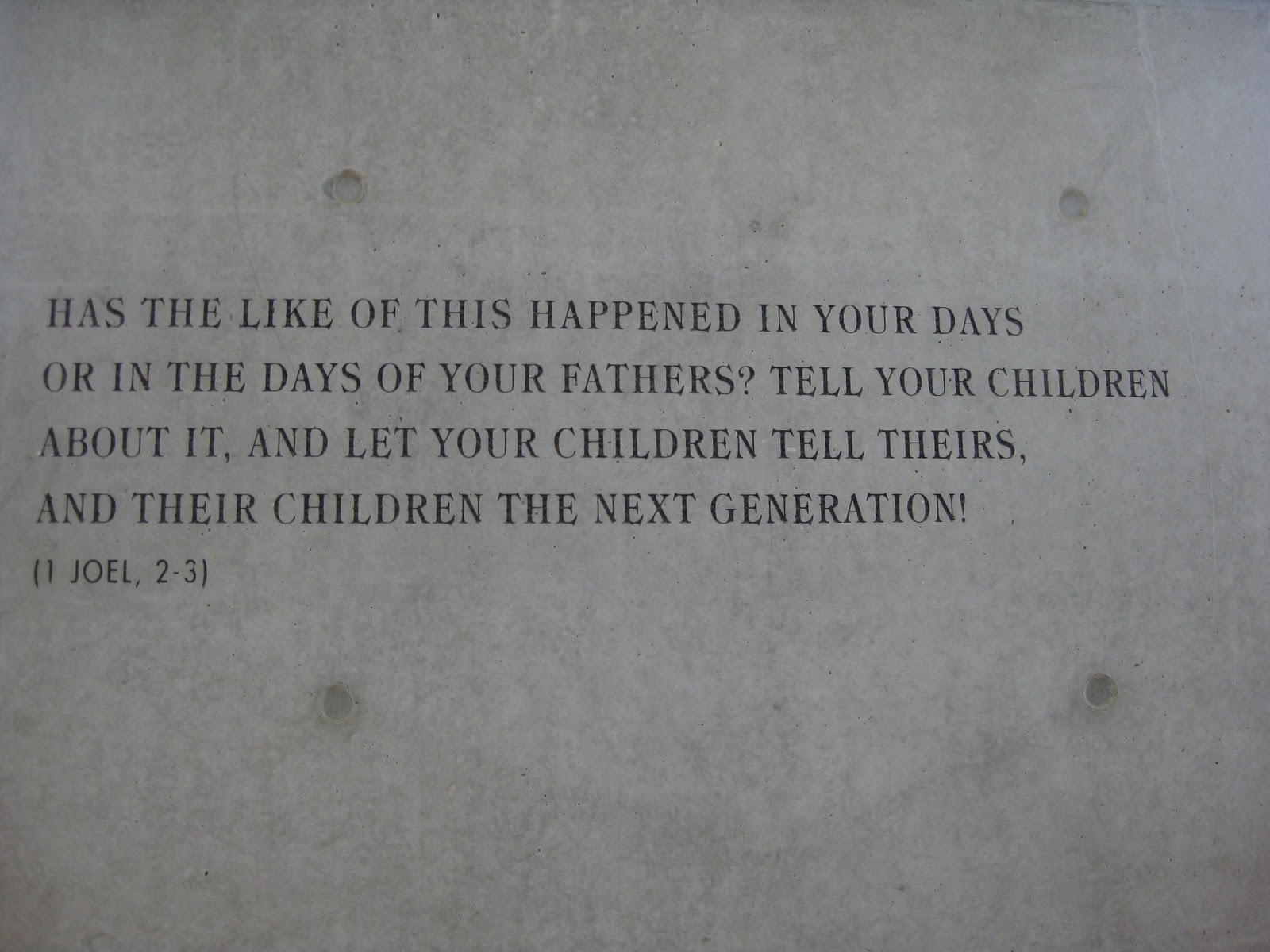
Quotation from Vad Yashem, the Holocaust Museum

Vad Yashem, the Holocaust Museum
Monument at Vad Yashem
by Paulina Muratore


At the Children's Memorial
By MacLean Cadman
A view of the valley from Yad Vashem.
Paulina Muratore


East Jerusalem
A market in East Jerusalem.
by Paulina Muratore

The Winding Wall
By MacLean Cadman


A Bedouin encampment outside of East Jerusalem.
by Paulina Muratore

A Demolished Palestinian Home
By MacLean Cadman


Walking down the hill to the Peace Center of
the Israeli Committee Against Home Demolitions (ICAHD)
with our guide, Yahav.
by Paulina Muratore


Mural at ICAHD's Peace Center.
by Paulina Muratore


Maqluba (a.k.a. Upside Down), a traditional Palestinian lunch. YUM!
by Paulina Muratore

Sunday, January 2, 2011

Going There: Aida and Hebron

Today, we visited Aida Refugee Camp and Hebron in the West Bank. Our own words cannot possibly describe all we have seen and heard, so we share with you several photographs because a picture is worth a thousand words. But first, a poem by R.S. Thomas, which articulates both the suffering and the grace we have witnessed.
 
The Coming
by R. S. Thomas
 
And God held in his hand
A small globe. Look he said.
The son looked. Far off,
As through water, he saw
A scorched land of fierce
Colour. The light burned
There; crusted buildings
Cast their shadows: a bright
Serpent, A river
Uncoiled itself, radiant
With slime. On a bare
Hill a bare tree saddened
The sky. many People
Held out their thin arms
To it, as though waiting
For a vanished April
To return to its crossed
Boughs. The son watched
Them. Let me go there, he said.
Aida Refugee Camp
Entrance to Aida
by Paulina Muratore

 A wall in Aida listing refugees' home villages.
by Paulina Muratore

Our lunch hosts at the Lajee Center in Aida.
by Paulina Muratore

 The Wall, sometimes called the Apartheid Wall, sometimes called The Fence.
by Paulina Muratore 

Children in Aida.
by Paulina Muratore
 

Ibrihimi Mosque
The beautiful room for prayer.
by MacLean Cadman


Several of us prepared for entering the room for prayer.
by MacLean Cadman

The 1,600 year old minbar, where the imam stands to deliver sermons.
by Paulina Muratore

Sarah's Tomb
by Paulina Muratore


Meeting Israeli Soldiers
At the checkpoint near the Ibrihimi Mosque.
by MacLean Cadman


Getting a little exercise!
by MacLean Cadman


Soldiers at our last checkpoint leaving Hebron.
by MacLean Cadman


Saturday, January 1, 2011

Seek Peace and Pursue It

This entry is part two of two entries for Saturday, January 1.

Barbed Wire Fence on Olive Tree Terrace
by Paulina Muratore
Class of 2013, International Relations
Boston University

One of the gifts of coming to a disputed land is meeting people who want to resolve conflicts not with violence but with civility, creativity, and a concern for the common humanity of everyone involved. Today, we met two such people, one a university professor who left a job at Yale University to focus on empowering non-violent approaches to the Israel-Palestine conflict from his home in Bethlehem; the other, a farmer committed to establishing good relations with his neighbors, to creating beautiful art, theater, and music with children in order to promote peace, and to making a space where people of all traditions and backgrounds can come together in peace. These men, Mazin B. Qumsiyeh, professor at Bethlehem and Birzeit Universities and a leader in several civil and solidarity movements, and Daoud Nassar, owner of Daher's Vineyard and director of Tent of Nations, are Palestinians with a passion for justice and peace. Their long-term dedication to the creation of opportunities for mutual respect between Palestinians and Israelis, despite the ongoing discord about land ownership and use, water access, human rights issues, and much more, was both a sobering and an energizing aspect of our journey today.

We met Qumsiyeh after spending the morning at the Church of the Nativity in Bethlehem. He welcomed us with hospitality, including a delicious Turkish coffee, and talked to us about his activist work. Qumsiyeh is deeply concerned about what is happening to Palestinians as Israelis build more walls, annex more land, uproot profitable and very old olive trees and vineyards, tap water resources underneath Palestinian-owned property, require Palestinians to carry special IDs, and control Palestinian movement throughout the region. It is clear that, despite his concerns for these and many other problems, Qumsiyeh follows the lead of globally-respected persons such as Mohandas Gandhi, Martin Luther King, Jr., and Desmond Tutu, as he tries to respond in a non-violent manner that still makes his political points. He told us what it means to him to be a Palestinian at this time, saying, "to exist is to resist." Resisting, for Qumsiyeh and the people he works with, does not mean violent acts; instead, resisting means farmers picking olives in front of bulldozers and women taking sheep to pasture in forbidden areas, children going to school in the streets when their schools are blocked off by Israeli military units, writing books and talking to groups about peace and justice, hugging trees about to be torn down or burned, refusing to pay taxes without representation, and other similar kinds of actions. His message is a message of hope and empowerment, one that draws inspiration from the anti-Apartheid movement, women's suffrage and feminist movements, and the like.

After we left Qumsiyeh, we had much to ponder on the short bus ride and walk across the terraced fields and up the hillside to Daher's Vineyard just outside of Bethlehem. We arrived at the farm to a delicious lunch prepared for us by Daoud Nassar and his family, after which Nassar told us his family's story of land ownership in a rich farming area where Israelis are currently annexing land and building new settlements very rapidly.

Lunch in a Cave at Daher's Vineyard
by Paulina Muratore

 The Nassar family bought their land in 1916 and have been farming it continuously in vineyards and olive trees and living in the caves on the land for three generations, but they have had to mount an extraordinary legal battle with Israelis for more than ten years in order to keep it despite having clear title to the entire property. The family was offered a large sum of money to give up the property rights to their 100 acres, but they refused because, Nassar said, "The land is our mother. We cannot sell our mother." They have endured nine demolition orders, all rescinded thus far, but they fear that the bulldozers could arrive at any time to destroy the few structures on the property. In addition to fighting the battle in court, the Nassar family's response to this situation has been to make something good come from the conflict. They host a summer camp for children and youths from the area; invite people, including Israeli settlers, to join them in working the land and sharing meals; and have been inventive in creating a self-sufficient farm with solar energy, rain water tanks, organic farming techniques, and good use of the natural caves on the property. They are not interested in theoretical peace-making but try to live it every day, from the grassroots up, whether they are engaged in hosting visitors like us or crossing through an Israeli check-point. As Nassar told us, "We refuse to be enemies." His goal, and that of his family and Tent of Nations is to develop friendships that will enable them to cross boundaries and solve problems together.

 Peaceful Resistance, Daher's Vineyard
by Paulina Muratore

As we said our goodbyes to Nassar and headed back down the hill and across the fields to the bus, we were struck by how these two good men are, in their own ways, seeking and pursuing a future of peace. Both want unity with their fellow human beings, and one approaches it by researching and writing books and engaging in non-violent political actions while the other plants olive trees and invites everyone to participate in the planting and the playing afterward. Their kind hospitality, their honesty, their diligence in the face of many obstacles, and their humor will stay with us through the rest of our journey and as we return home to all of you.

~ Shan Overton
PhD student, Theology & Education
Boston College

Behold, how good and how pleasant it is 
for brethren to dwell together in unity!
~ Psalm 133 (KJV)

Most of Our (Very Unified) Group at Church of the Nativity!
by Paulina Muratore


Visit to Bethlehem

This is part one of a two-part entry for January 1, 2011.

Hello again to all our followers,


Today was a nonstop barrage of action. After breakfast, we drove to Bethlehem and its Church of the Nativity, where tradition tells us Jesus was born. The trip was only seven or so miles, but there was plenty to see on the way – another glimpse of the Old City, some very cool ancient architecture, and the controversial wall that separates Israel from the West Bank. Some call it a security barrier, some call it the Apartheid Wall. Whatever its name, it is quite an intimidating sight – a concrete behemoth standing over twenty feet, guarded by Israeli soldiers toting machine guns.

 Meeting Our Guide at the Church of the Nativity
by Paulina Muratore


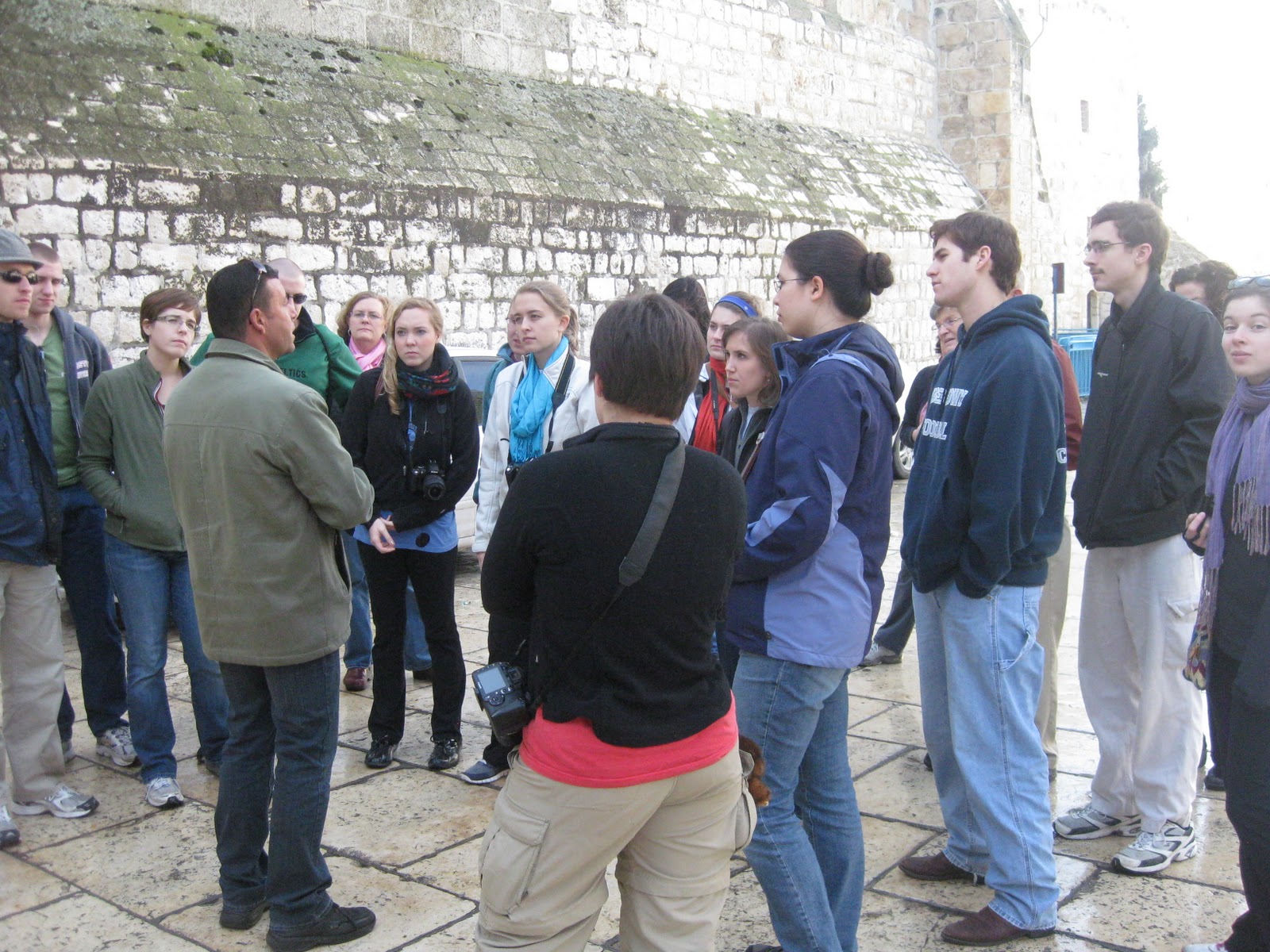
After passing through the checkpoint, we arrived at the Church of the Nativity and met our tour guide, Isa (which is the Arabic version of “Jesus”). He led us inside, chuckling as we were forced to crouch while entering the tiny stone door that had been built hundreds of years ago to prevent people from bringing livestock into the church. 

 Door to Nativity
by MacLean Cadman

We stepped into an enormous cathedral, lined by giant pillars and decorated with countless chandeliers, paintings, and relief sculptures. Everywhere we looked, there was something that demanded closer attention – a faded script on a pillar, shimmering jewels on the chandeliers, various crosses and other religious symbols etched into the stone. Isa explained how the church had been rebuilt three times over the millennia, and how each had added to its structure and décor.

 The Crowded Descent into the Grotto
by MacLean Cadman

Then it was time to descend to the grotto that was built – supposedly – upon the stable where Jesus was born. As Bob Tobin said about a few holy sites today, “It may not be the spot, but it is the place.” Pushing and shoving – we were competing with several other tour groups to enter the grotto, including an especially determined Indian family – we stepped into the cramped space where our Lord Christ was born. A silver fourteen-point star marked the exact place where Mary gave birth. As was custom, people were kneeling to touch or kiss the star and whisper a quick prayer, or snap a picture. The spiritual atmosphere was somewhat interrupted by the fact that we only had a few seconds before being shoved aside by the next anxious tourists, but it was still a powerful experience.

 The Birthplace of Jesus
by MacLean Cadman

Next, we tiptoed through the back of a Spanish Mass and descended into a series of caves that houses both the tomb of St. Jerome and the room where he translated the Bible into Latin. The tomb is empty, however; Crusaders removed his bones, many think to the basilica of Santa Maria Maggiore in Rome. Then, Isa led us up and out into the church’s courtyard. He gave us the Palestinian perspective of the 2003 siege, where Palestinian gunmen had sought refuge from Israeli forces by hiding in the church. Over the course of the month-long holdup, Israeli snipers shot down five to eight people, including one of the church’s monks. The bullet holes in the upper wall of the courtyard are still clearly visible.

 Bullet Holes in The Church of the Nativity
by MacLean Cadman

Another stop later in the day took us to Shepherd’s Field, where the shepherds, watching their flocks by night, saw the star that led them to Jesus. It is not so much a field anymore – stone walkways, fountains, and a chapel dominate the space – but it retains its sense of holiness. Across the street is a co-operative run by a Palestinian family, selling beautiful sculptures handcrafted from olive trees and other attractive souvenirs. After some not-so-brief browsing, we made the short walk to the Grotto Restaurant and filled up on the traditional three-course meal of pita bread with several creative and tasty fillings, salad doused in olive oil, and chicken and lamb with less-traditional french fries.

At last, we were driven, sleepy and content, back to the guesthouse – interrupted by the checkpoint at the barrier, where the bus was boarded by Israeli soldiers who could not have been much older than us. The automatic weapon which one carried looked to be about half her size. But a few smiles, New Year’s wishes and, more importantly, passports, got us through without incident. We returned to St. George’s for a short period of discussion and, to everyone’s relief, bedtime (except for those involved with keeping up the blog, but of course we won’t complain!)

We’ll be checking in again tomorrow. Have a good day, night, whatever it is over there, and thanks for reading!

~ MacLean Cadman
2012, Communication
Boston College

Friday, December 31, 2010

We're Here ~ Still Smiling!

Hello All,

We have reached the Holy Land! Everyone is safely and comfortably settled into St. George's Guesthouse in Jerusalem. Most of us slept on the flight from Paris, but those who kept their eyes open were treated to an incredible sight as we broke free of the clouds shrouding the city.  A pure white tundra greeted us, rolling far as the eye could see.

Above the Clouds
by Paulina Muratore
Class of 2013, International Relations
Boston University

That wasn't the only spectacular sight - viewing the Alps from far above was just as beautiful. After four hours, we descended back into the clouds to land at Ben Gurion Airport in Tel Aviv.

 Landing in Tel Aviv
by Paulina Muratore

After yawning and shuffling our way through customs, we met one of our guides, Naim. Naim is Palestinian, an Arab-Christian, and an old friend of the Tobins. He went under for heart surgery only a few weeks ago, but still had the energy to make the trip out to greet us! He gave us a quick brief of what we are to experience for the next week and a half, and we began the hour-long bus ride to Jerusalem.

 On the Bus
by MacLean Cadman

Naim was kind enough to point out the sites to us, including several former Palestinian villages along the way, and the American consulate and the Old City once we reached Jerusalem.

Upon settling into St. George's, we had a nice dinner - courtesy of the guesthouse staff - and moved to the chapel for a quick Compline service before everyone went off to do their own thing - namely, either sleep or wait till the New Year for a glass of champagne.

 Welcome to Jerusalem
by Paulina Muratore

Tomorrow, it's to Bethlehem, visiting a vineyard and the Tent of Nations. We'll be planting olive trees in the afternoon, so for those of you who made contributions, thank you! We'll have our next post up soon. Happy New Year to all, and God bless!
~ MacLean Cadman
Class of 2012, Communications
Boston College

Smile at the Ben Gurion Airport in Tel Aviv
by MacLean Cadman