Leaving Akagera
We left Akagera National Park today after a very eventful couple of days, headed for the dedication ceremony of a home built by genocide perpetrators for a survivor. As we left for Kirehe by the park road, we saw more animals--an unexpected treat!

Baboons say goodbye at the entrance to Akagera Game Lodge.
These creatures roam freely all over the lodge grounds and will go through your bags looking for food if you leave them unattended!

Baboons, or igitera in Kinyarwanda, took over the Akagera Game Lodge in the aftermath of the 1994 genocide, moving themselves into the rooms and eating all the food they could find.
Apparently, they did a lot of damage to the lodge, and it took the owners many months to reclaim it.

Excitement again! Zebras and a baby Maasai giraffe!

This baby is VERY tall and eats leaves from the Acacia trees.
She/he was breakfasting along the road out of Akagera.

This is a sweet face not only a mother could love. Just gorgeous!
Traveling To Kirehe
The village where the house dedication ceremony was taking place is called Kirehe, which is in southeastern Rwanda near the Tanzania border. This area is much more rural than the Kigali region and contains coffee farms, banana farms, subsistence farms, and very small villages. It is extraordinarily vibrant countryside, as our photos attest.

The countryside on the way to Kirehe. Lush!

A man working his corn and sunflower field.
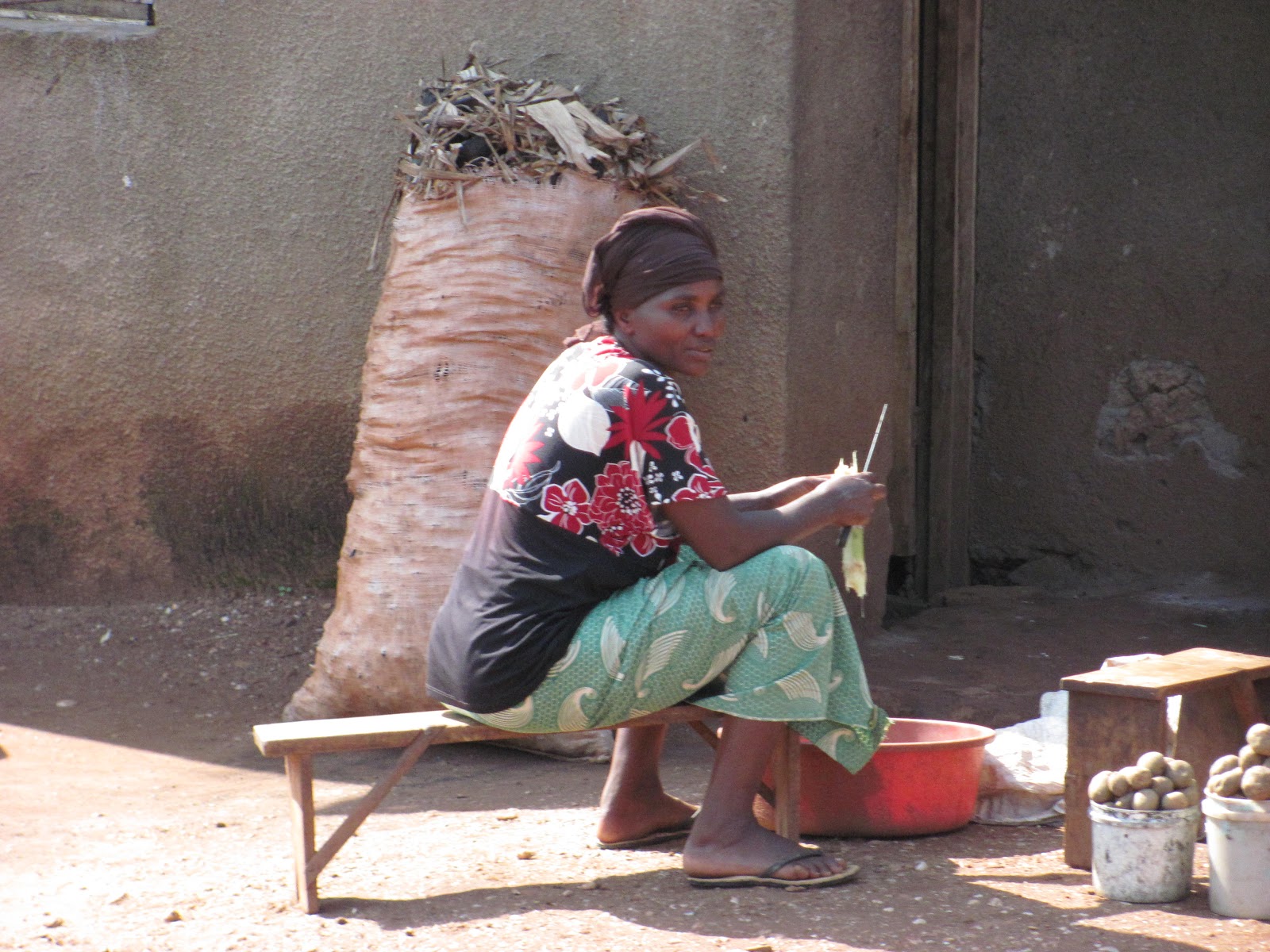
A woman working at home.

Youths walk along a village road.

A woman carries goods on her way home from the market.

A young man carries a load of sticks.
The Home Dedication of Consiensa
When we arrived in the village of Kirehe, we were greeted warmly by the people. There were about 400 people in attendance to celebrate the building and habitation of this lovely new home for Consiensa, who is a survivor of the 1994 genocide. The dedication of her home is the culmination of a long process of reconciliation between survivors and perpetrators of the genocide. We were privileged to witness the ceremony that marks the long road of healing and forgiveness, a process sponsored by REACH Rwanda, our hosts during our stay here.

Consiensa, in yellow and flower print in the center of the photo, is the survivor who owns the new house. For several years, she has been involved in a process of reconciliation with those who killed her family. The perpetrators against her, along with other perpetrators, volunteered to build the home.
At over four hours, the ceremony was long--by Western standards!--and included multiple songs by the talented REACH Rwanda choir, prayers by various clergy people, testimonies by perpetrators and survivors, speeches by local and national dignitaries, and testimonies by the international visitors from Japan and the United States (us!).

The REACH Rwanda choir sings a welcoming song.

Fr. Fidele, a REACH Rwanda staff member and Orthodox Anglican priest, prays over the crowd.

The choir performs another song, this time with dancers.

A dancer/singer with the choir.
At a certain point in the ceremony, genocide perpetrators were invited to come out in front of the crowd. This group--mostly of men--includes people who have served time in prison and performed required community service after release for their role(s) in the genocide. These people are from the village Kirehe, and they returned here after serving their sentences. They are Hutus who may have murdered their Tutsi neighbors, looted and burned houses, raped female villagers, tortured people, harmed children, and other crimes. Part of the challenge facing Rwandans in this post-genocide era is how to knit communities back together after such horror. Is it possible to reintegrate murderers back into the fabric of society after they have committed atrocities? Rwanda decided that it was not only possible; it is necessary for them to reintegrate people in order to rebuild after the devastation of their nation. Several million people were involved in the genocide, and it was practically impossible to keep them all in prison indefinitely--the government could not afford that number of prison cells and that amount of food and medical care, nor could the country rebuild with a huge portion of its population in prison. Additionally, social and spiritual reconciliation was desperately needed to allow neighbors to face neighbors once again and to prevent the possibility of future genocides. About genocide, many people around the world say, "Never again." The Rwandans are striving to live fully into this commitment by fostering real, living reconciliation between people who have been deeply divided.

These people were the perpetrators of the genocide.
We heard the confessions of some of them.

This man spoke of his role in the genocide and of his commitment to reconciliation.
He is one of the many perpetrators who helped build the new house.

This woman was a child during the genocide, and she did not commit any crimes. However, her family committed crimes against their neighbors. In order to atone for her family's sins, to show good faith with her neighbors, and to support the process of reconciliation, she chose to join REACH Rwanda's project voluntarily.
Her family members who perpetrated the genocide are now dead.
In their testimonies, the perpetrators spoke of their realization of the evil of genocide, their understanding of their own sin in participating, and the consequences of such behavior. They spoke of needing to do extra service beyond their prison sentences and government-mandated community service. One man said he felt he needed to do something that came out of his own heart, and his volunteering to participate in this house building project is one way he is enacting that heart-felt desire for reconciliation. Another man looted and burned houses and did not stop his friends from killing Tutsis, including the family of our hostess, despite his leadership role in the community. He told us that genocide is not just something done to Rwandans--but is a crime against the whole world. He understands his failure to save Consiensa's family as an affront to the entire human race. A third man spoke about this house dedication as a rebaptism of the hill where this new house sits. He said the genocide made it a bad place, but this process of reconciliation makes it a new place, a good place, a place where people can live together in peace and unity.

Another perpetrator whose story we heard.
After hearing from the perpetrators, we heard from the survivors who have forgiven them. First, the owner of the new house spoke to us about how, after the genocide was over, she was in a very bad state. Anytime Consiensa encountered perpetrators in the village, she would not speak to them, and she lived in an isolated and secluded way. She was very alone, having lost her family and feeling divided from many in her village. Through the process of reconciliation with REACH Rwanda, she was able to become closer to offenders, to share her story of pain with them, and to hear their apologies for their crimes. She told us that, now, she lives in peace with them because she has learned to accept the loss of her loved ones and to appreciate her own life. She is grateful for having a house to live in and asked God to bless REACH.

Our hostess, Consiensa.
Another woman, Lydia, told of how she lost her husband and children in the genocide. The perpetrators killed her husband and threw her young children into the waterfall at Rusumo, where the Akagera River passes across the Rwanda-Tanzania border. She told us that gathering together with women whose husbands committed these crimes was very difficult for her. Eventually, through the process with REACH, she was able to talk with these women and develop a basket weaving project with them in order to benefit all of them economically. She has also integrated the man who killed her family into her daily life and her special celebrations--they talk on the phone and consider each other to be friends. Lydia believes that reconciliation helped her to put aside the burdens she was carrying so that she could live a life worth living. She testified that REACH helped her address the trauma she experienced as a result of the genocide, and now she trains people to help others with PTSD and other results of trauma. For her, recovery and forgiveness is only possible with others--she emphasized that we must work toward it together.

Lydia
There were many other survivors in the ceremony, including Vivienne, who was badly injured by a machete and bears deep scars on her face and body. Vivienne managed to escape to Tanzania after her perpetrators left her for dead. Miraculously, she survived her wounds and her exile, and she eventually returned to take care of orphans left behind in the wake of the genocide. She told us that she has forgiven one man who tried to kill her--he was with her on this day, and she shook his hand. She said that any other who had harmed her and who wanted forgiveness from her should come to her and ask for it; she will gladly give it.

Vivienne

Fr. Philbert Kalisa (center), founder and director of REACH Rwanda, is introduced to the gathering.
Because the crowd was so large, not everyone could enter the house for the many blessings said over it by clergy people from the community and around Rwanda and the world. The following photographs were given to us by one of the members of the Japanese delegation, Shinichi West, who was able to accompany the smaller crowd into the home.
The front door of the beautiful new house.
Photograph courtesy of Shinichi West of the Japanese delegation.
Local dignitaries, ministers, and the homeowner step inside for the house blessing.
Photo courtesy of Shinichi West of the Japanese delegation.
Our own Bishop Tom Shaw of the Diocese of Massachusetts prays one of the blessings upon the new home.
Photo courtesy of Shinichi West of the Japanese delegation.
As butterflies wafted through the gathering after the dedication was complete, members of the Japanese delegation spoke, and then they led us in a song, "God Is Good To Me," which we sang in English, Japanese, and Kinyarwandan. Throughout our trip, we have crossed paths with the Japanese delegation and have felt glad to hear about their commitment to the reconciliation process in Rwanda and to get to know them as people. They are a group of Baptists who have been engaged with Rwanda's healing process since very soon after the genocide, and we honor them for their work.
We were also asked to introduce ourselves and to speak, and we did so by sending MacLean Cadman and Bishop Tom Shaw to speak on our behalf. First, MacLean offered his testimony about what he has learned since coming to Rwanda; then, Bishop Shaw spoke about what Rwandans are teaching us with their work in peacemaking, forgiveness, and healing. We offer MacLean's words here in their entirety.
We were also asked to introduce ourselves and to speak, and we did so by sending MacLean Cadman and Bishop Tom Shaw to speak on our behalf. First, MacLean offered his testimony about what he has learned since coming to Rwanda; then, Bishop Shaw spoke about what Rwandans are teaching us with their work in peacemaking, forgiveness, and healing. We offer MacLean's words here in their entirety.

MacLean Cadman, senior at Boston College, offers his testimony on behalf of our group.
MacLean Cadman’s Reflection
“The last few days have been one of the most difficult and amazing experiences of my life. I’ve never been so directly confronted with the evil that people can do to one another. I’m sure this is the case for most, but I never could comprehend the huge numbers that come with tragedies like the genocide here. There’s usually an ocean or two separating us from such tragedy, and what’s on television is a product meant to be seen, but not really experienced. So it’s always been difficult for me to relate to events like this on a personal and profound level.
“But for me at least, death on that level became much more real when we visited the Murambi Genocide Memorial the other day and saw the hundreds of bodies in the classrooms. Just seeing some of the dead represented by their actual corpses confronted me in a very intrusive way. In my mind, it transformed the massacre from a single notion of death with a number attached to it, to the deaths of 50,000 individuals with bodies I could see, and whose corpses were different in ways that I’m sure are just a fraction of their uniqueness in life. I felt like I was struck hundreds of times over by tragedy of the killing with each body I saw. The experience left me asking the question of theodicy more intently than I ever had before; I could not stop thinking, “Where was God during this massacre?” I don’t think I’ll ever be able to answer that, but there is one thing I am sure of: That Jesus suffered with every single Rwandan who was tortured, raped, or killed during the genocide.
“But just like the gospel, the story doesn’t end with death; it continues with resurrection. And that part, Rwanda has done better than any nation or people I’ve heard of. I had always wondered how Rwanda transformed itself from a broken country, devastated by evil, to such a model of reconciliation. And I got my answer when we visited the Rwandan youth groups. Their love and joy in Christ, and their willingness to forgive is as much a resurrection of Jesus as anything I’ve seen. I loved seeing those Rwandans sing and dance because every song and every dance is a triumph over the evil and death that happened here before. For all the corpses we saw lying in those classrooms, there are even more Rwandans willing to forgive those deaths and share in the love of Christ. Genocide has happened before Rwanda, but reconciliation and love on this scale so soon after, I think, hasn’t. What we are witnessing here with those youth groups, and REACH Rwanda and Father Philbert, is a reborn Rwanda saved by Christ. It really is a resurrection."

Bishop Tom Shaw speaks to Consiensa, thanking her on her commitment to reconciliation and for the witness she provides to Americans and others around the world.
For us, this experience of witnessing the results of this remarkable journey into the heart of forgiveness is inspiring and causes us to ask questions of ourselves. How far are we willing to delve into reconciliation? Do we forgive people who have harmed us in our lives? If we have, what is our motivation? If we have not, why not? Does the person who caused the harm need to ask for forgiveness in order for the person harmed to offer forgiveness? How does this process work not only in our individual lives, but societally? How does God want us to engage reconciliation in our lives? There is much to ponder about reconciliation. We know that it is powerful and meaningful in the lives of the people of Kirehe and around Rwanda. What about in the United States? We take these questions home with us, and we will ponder what we have witnessed here in Rwanda. The home dedication has given us a tangible and community-based approach to reconciling across differences that seem insurmountable from one angle. We are grateful for the opportunity to learn from Rwandans about what it means to be humans and to be Christians. They have taught us what baptism really means.

Colorfully dressed women listen to the speakers.

A child enjoys the music of the REACH choir!
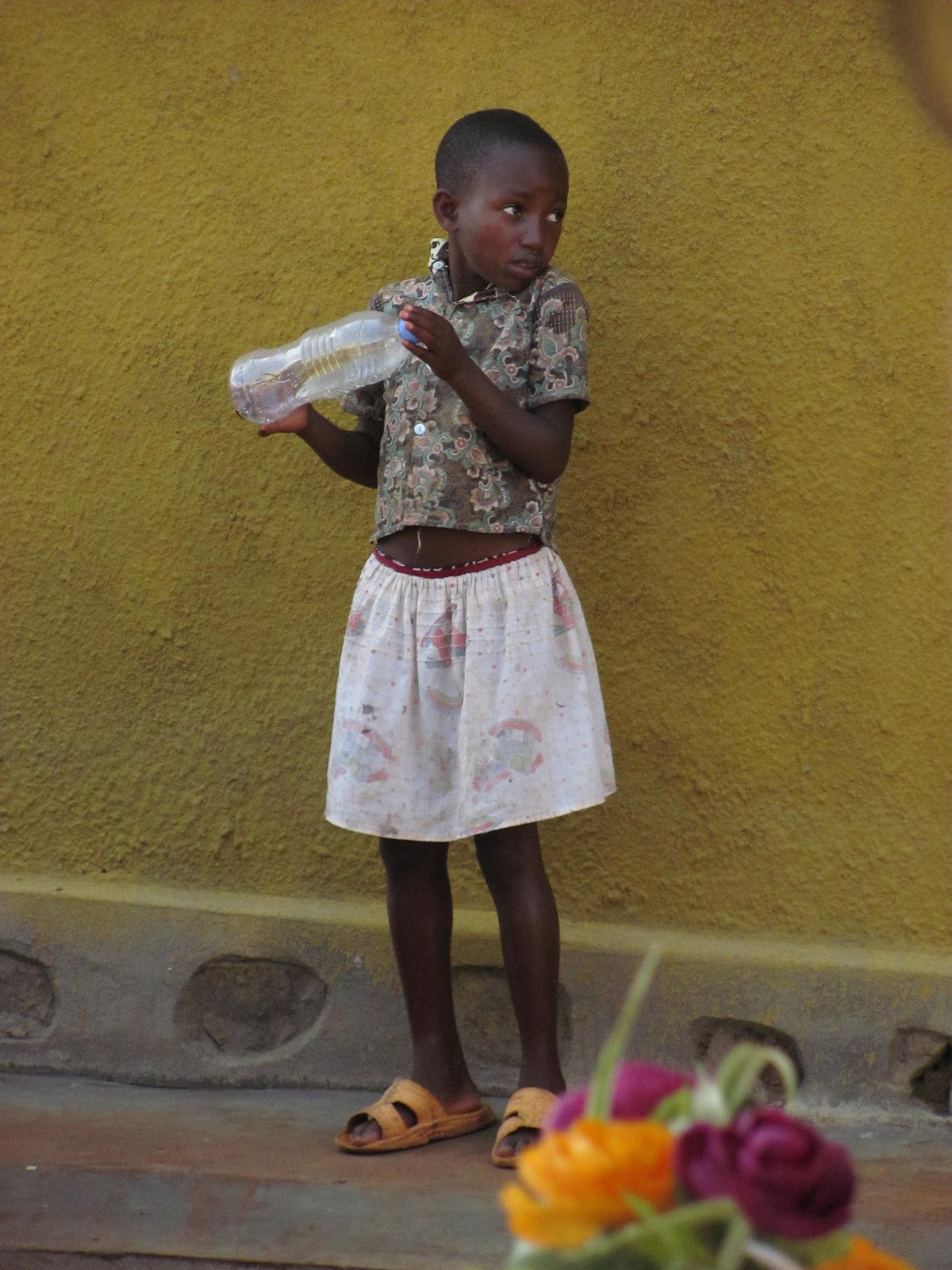
A girl stands in the shade during the festivities.
~ To learn more about the work of REACH Rwanda, see their website at:
http://www.reach-rwanda.org/


